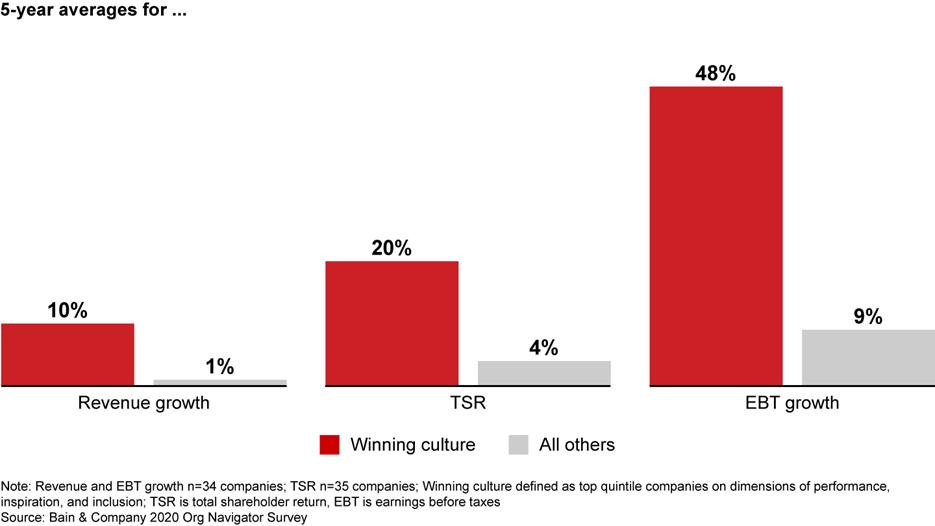
Companies with a high-performance culture grow 10x faster—does yours?

When I was leading the EMEA Finance team at Cepheid, I initially found myself at the center of every decision. As the company scaled, I had to learn how to delegate and empower my team to make key calls—without micromanaging. Thanks to my manager who pushed me to let go and trust my team, I learned that empowering others wasn’t just necessary—it was the only way to sustain high performance in a company growing 20% annually. Scaling isn’t about doing more—it’s about stepping back so others can step up.
Scaling from $100M to $1B isn’t just about strategy, funding, or product-market fit. It’s about building a culture that sustains high performance—one that attracts top talent, fosters innovation, and maintains agility despite rapid growth.
Too often, companies focus on processes and numbers, forgetting that culture is the engine behind long-term success. A weak or misaligned culture leads to disengagement, slow decision-making and threatens sustainable growth. In MedTech, culture isn’t just about efficiency; it’s about saving lives. Teams must be deeply connected to the impact of their work—developing life-changing technologies that improve patient outcomes.
So, how do you create a growth mindset and high-performance culture as you scale?
1️⃣Shift from a founder-led culture to a high-performing scalable culture
In early-stage MedTech companies, culture is often shaped by the founders’ vision and direct influence. But as the organization grows, relying on personal leadership alone is not scalable.
✅ Define a shared vision with a focus on impact: A clear, patient-centered vision ensures that every decision aligns with improving lives and drives a culture of meaningful innovation.
✅ Embed culture in processes: Hiring, onboarding, and performance management should reinforce the mindset and behaviors you want to sustain.
✅ Scale leadership, not just operations: Founders and executives must transition from being the sole decision-makers to empowering the next generation of leaders.
✅ Empower people and maintain accountability: Employees must have the autonomy to think creatively while being held responsible for outcomes.
According to Bain & Company, high-performance cultures share three key traits: inspirational leadership, a strong sense of accountability, and an environment that fosters continuous learning. Companies that intentionally embed these traits see improved engagement, retention, and innovation (Bain & Company, 2024). In MedTech, this also means ensuring that everyone—from R&D to Customer Service —understands their role in creating a tangible impact.
💡How to implement:
✔ Hold regular “patient impact” sessions where teams hear real stories about how their technology is improving lives.
✔ Build leadership development programs that focus on transitioning from technical expertise to strategic leadership.
✔ Align incentives with impact—reward teams not just for hitting revenue targets, but also for innovations that improve patient care.
2️⃣Cultivate a growth mindset, trust, and empowerment
A company with a fixed mindset sees setbacks as failures. A company with a growth mindset sees them as learning opportunities. But fostering a growth mindset also requires trust—employees must feel safe to take risks, make mistakes, and learn from them.
✅ Encourage experimentation: Create an environment where teams are empowered to test, learn, and iterate—without fear of failure.
✅ Fail fast: Recognize employees who take calculated risks and extract insights, even if the outcome wasn’t ideal. Test early, learn and adjust as needed.
✅ Balance accountability with empowerment: Teams perform best when they have autonomy but are also held responsible for results.
✅ Build a culture of trust: Honest feedback and psychological safety must be embedded at all levels.
Penumbra, a MedTech company specializing in vascular and neurovascular devices, exemplifies this. CEO Adam Elsesser emphasizes a culture that encourages employees to take risks without fear of punishment. As he puts it, “Our team has this attitude that allows them to always be open to learning what they don’t know, and not being afraid to fail.” This has resulted in rapid innovation and high employee retention, as team members feel empowered to explore new ideas (MDDI Online).
💡How to implement:
✔ Create an environment where failure is not stigmatized but seen as a natural part of the innovation process.
✔ Establish a structured debrief process after product launches or regulatory approvals to capture learnings.
✔ Encourage open dialogue where employees feel comfortable discussing challenges without fear of blame.
3️⃣Hire (and retain) people who scale with you
The talent that gets you to $100M may not be the same talent that takes you to $1B.
✅ Look Beyond Immediate Needs: Hire leaders who can operate at scale, not just those who fit today’s challenges.
✅ Prioritize Cultural Fit with a Growth Orientation: Skills can be developed, but adaptability and resilience are harder to teach.
✅ Create Clear Paths for Internal Growth: When employees see long-term opportunities within the company, they are more likely to stay and contribute to scaling efforts.
A culture of performance must also include honest and constructive feedback. Companies that scale effectively create a feedback-rich environment where employees receive continuous input to grow and improve.
💡How to implement:
✔ Develop career tracks that allow high-potential employees to grow into leadership roles without leaving the company.
✔ Invest in mentorship programs where senior leaders guide the next generation.
✔ Offer employees access to conferences and encourage them to visit customers on a regular basis to stay in touch with the company’s mission.
4️⃣Keep agility while growing in size
Large organizations tend to become bureaucratic and slow—the opposite of what fueled early success.
✅ Decentralize decision-making: Empower teams to make decisions quickly without layers of approval.
✅ Maintain a bias for action: Avoid over-analysis and encourage rapid execution and iteration.
✅ Foster cross-functional problem-solving: Encourage teams from different disciplines to work together on challenges.
💡How to implement:
✔ Set up cross-functional “innovation squads” focused on solving specific challenges.
✔ Reduce unnecessary layers of approvals in critical decision-making processes.
✔ Use real-time performance dashboards with customer-centric KPI’s to keep teams aligned and accountable.
Scaling culture is a competitive advantage
Those that create a strong, adaptable, and high-performance culture will not only reach $1B faster but will do so with resilience and profitability.
💬 What’s your experience? Which of these cultural shifts do you think is hardest for MedTech companies? Let me know in the comments!
Your Growth journey starts here
📩 Subscribe to join industry leaders and innovators in exploring the path to sustainable growth in MedTech.
🔹Next Up : Best Team wins; Talent Development & Retention.
💡Have a topic you’d like to see covered? Reply and let me know !